Food in Hanoi: what and where locals actually eat
Where Hanoians really eat — the pho counters that sell out by 10am, the noon bun bowls, the plastic-stool bia hoi corners and the egg-coffee alleys — with real dishes, addresses and 2026 prices, and the tourist traps to walk straight past.
Pho is breakfast, and the good shops sell out by 10am
Hanoians eat pho in the morning, not for dinner, and the best rooms are empty by mid-morning because they have run out. The benchmark is Pho Gia Truyen at 49 Bat Dan, a bare, queue-out-the-door place where a bowl of pho bo runs 50,000-60,000 VND (about $2.20); you pay at the counter, carry your own bowl and share a table with strangers. For the divisive alternative, Pho Thin at 13 Lo Duc stir-fries the beef in oil before it meets the broth, giving a darker, richer bowl at around 60,000 VND. Pho 10 Ly Quoc Su is the tidiest choice for nervous first-timers, English menu and all, at 65,000-80,000 VND.
Order by cut, not by guesswork: tai is rare beef, chin is well-done brisket, nam is flank, gau is fatty, and tai nam covers you if you cannot decide. Chicken pho — pho ga — is the quieter, cleaner cousin, and Pho Ga Nguyet at 5B Phu Doan does the definitive version for about 50,000 VND. Skip the pho sold after 9pm near Hoan Kiem lake aimed squarely at tourists; the broth has usually been sitting for hours and costs double. The local rule is simple — eat pho where you see office workers and grandmothers on plastic stools before mid-morning, and walk on if the place sits empty.
At noon the city switches to bun
Come lunchtime, Hanoi turns from pho to bun — soft round rice noodles served a dozen ways. Bun cha is the definitive Hanoi lunch: grilled pork patties and belly in a warm sweet-sour fish-sauce broth, with a basket of herbs and a side of nem cua be, crab spring rolls. Bun Cha Huong Lien at 24 Le Van Huu is famous as the spot Obama and Anthony Bourdain ate at in 2016, and the 'Combo Obama' still costs about 85,000 VND; locals rate Bun Cha Dac Kim at 1 Hang Manh just as highly at 60,000-70,000 VND, though it is busier and pushier at the door.
Beyond bun cha, learn three more. Bun bo Nam Bo is a dry southern-style bowl of beef, peanuts and crispy shallots, best at Bun Bo Nam Bo Bach Phuong, 67 Hang Dieu, for 60,000 VND. Bun rieu, a tomato-and-crab-paste broth, sells from morning carts around Hoan Kiem for 35,000-40,000 VND. Bun oc, the tart snail noodle soup, is a genuine Hanoi specialty, best near Truc Bach lake for about 45,000 VND. Bun dau mam tom — fried tofu with fermented shrimp paste — is the one to approach carefully; the pungent purple dip divides even Vietnamese eaters, but a plate at Bun Dau Ngo Gach costs barely 50,000 VND.
Snacks and grab-and-go: banh mi, banh cuon, xoi
Between meals, Hanoi runs on cheap handheld food. Banh mi here is smaller and less loaded than the Saigon version; Banh Mi 25 at 25 Hang Ca is the reliable pick at 25,000-35,000 VND, with a seating annex across the lane. For banh cuon — steamed rice sheets rolled around minced pork and wood-ear mushroom, showered with fried shallots — go to Banh Cuon Ba Hanh at 26B Tho Xuong near the cathedral, around 40,000 VND. Xoi, sticky rice topped with mung bean, shredded chicken or braised pork, is the classic grab-and-go breakfast: Xoi Yen at 35B Nguyen Huu Huan is the institution, 30,000-50,000 VND a bowl.
The snacks worth crossing town for are seasonal and specific. Banh gio, a warm pyramid of rice-flour dumpling with pork and wood-ear mushroom, is a 15,000 VND cart-corner staple. Nem chua ran — fried fermented pork bites — belong to Tam Thuong alley off Hang Bong, eaten with chilli sauce and cold beer for a few dollars. In autumn, look for com, young green rice pounded flat and sold wrapped in lotus leaf around West Lake villages like Vong; it is a Hanoi obsession you will not find in the south. Buy these from carts with a steady local queue, and eat them the same hour you buy them.
Where locals actually sit down
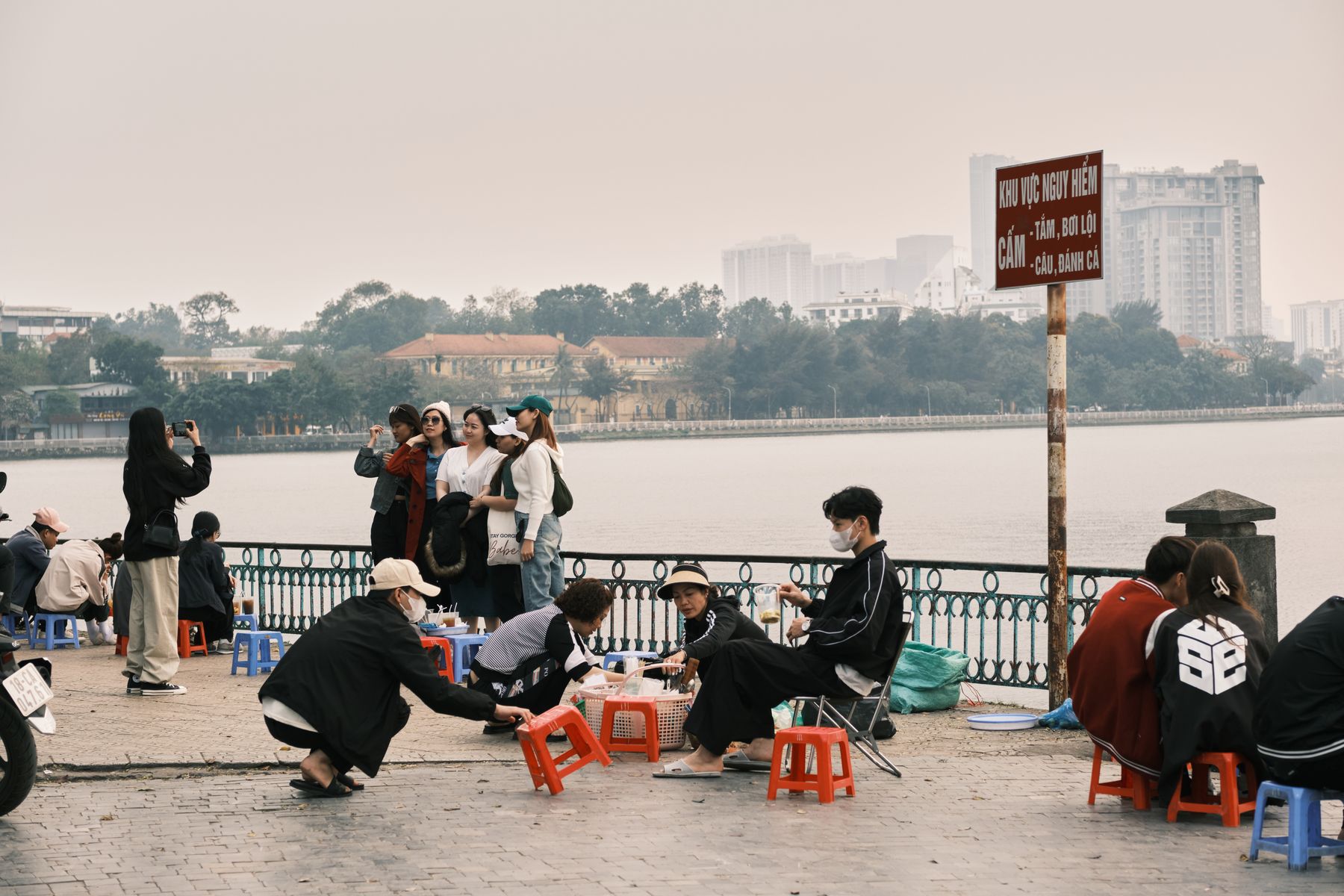
The tourist map and the local map barely overlap. Locals eat on the pavement, on knee-high plastic stools, at com binh dan — 'people's rice' shops — where you point at trays of braised fish, tofu, stir-fried greens and pork and pay 40,000-60,000 VND for a full lunch; Old Quarter examples cluster on Hang Bo and Cau Go. For hotpot and grilled meat with friends, Hanoians head to the lau strip on Phung Hung or the beer-and-food lanes around Truc Bach, not the Old Quarter's English-menu restaurants. Dong Xuan market's back-alley food court, on Cau Dong behind the market, is where traders eat bun rieu and bun oc all day long.
The single most local ritual is bia hoi — fresh draught beer brewed that morning and poured for 8,000-15,000 VND a glass at the Ta Hien and Luong Ngoc Quyen corner from late afternoon. It comes with nem chua ran, grilled skewers, fried peanuts and squid, and it is where the city unwinds. It gets rowdy and touristy after 9pm, so arrive by 5-6pm for the genuine after-work crowd. Reserve nothing at any of these; you sit where there is space, share tables and pay at the end. If a place has a laminated photo menu and a tout at the door, walk one street back and the prices halve.
The sit-down specialties worth a proper table
A few Hanoi dishes justify a real table. Cha ca — turmeric-and-dill fried fish you finish yourself over a tabletop brazier — is the signature; Cha Ca Thang Long at 21 Duong Thanh charges about 170,000 VND per person, and the original Cha Ca La Vong on the street now named after the dish is pricier and coasts on its history. Banh tom Ho Tay, sweet-potato-and-shrimp fritters, is the classic West Lake sit-down at Banh Tom Ho Tay on the Thanh Nien causeway, around 120,000 VND for a plate to share with the lake view. Both are dishes you eat at a table rather than a stool, and both reward going hungry.
For a full northern spread with table service, Cau Go overlooking Hoan Kiem and Chim Sao on Ngo Hue both do refined Hanoi cooking for 250,000-400,000 VND a head — the upper end of local eating, still a fraction of Western prices. This is the tier to book a day ahead on weekends; the street stalls never take reservations but these do. Skip the 'traditional Vietnamese' restaurants clustered on Ma May and Hang Be with staff waving menus outside; they are engineered for tour groups, portions run small, and a bowl of pho there costs what a whole meal costs two streets back.
Coffee, sweets and getting the timing right
No food day in Hanoi ends without coffee, and the local order is not a latte. Ca phe trung — egg coffee, a custard of whipped yolk and condensed milk over strong coffee — was invented at Cafe Giang, now down an alley at 39 Nguyen Huu Huan, where it still costs 30,000-40,000 VND. Ca phe sua da, iced coffee with condensed milk, is the everyday 20,000-25,000 VND cup from any pavement stall. For dessert, che — a sweet cup of beans, jelly and coconut milk — is sold along Hang Dieu for 20,000-30,000 VND and is the after-lunch treat locals actually order in the heat.
Timing decides everything. Eat pho and xoi before 9am, bun and com binh dan between 11am and 1pm, snacks mid-afternoon, and bia hoi from 5pm — chase a dish at the wrong hour and you get the reheated tourist version. Budget realistically: 150,000-250,000 VND ($6-10) a day feeds you well on street food, and even the sit-down specialties rarely push a couple past $30. Carry small notes, since no cart makes change for a 500,000 VND bill, and follow the queues of locals over any online ranking — in Hanoi the busiest plastic-stool corner is almost always the right answer.
Questions, answered
Hotels in Hanoi
See all stays →Curated picks are coming — meanwhile, the live search covers every bookable property at the same price or better.